

Priya, a brand manager in her Mumbai office, sipping chai while wrestling with spreadsheets that tease global success but deliver only frustration. Her D2C jewelry line flourishes in India, yet pushing into the US and Europe feels like sailing blind through a tempest. What is international pricing? It’s the craft of crafting prices that succeed across borders, countering price pressure from rivals while matching customer willingness to pay. In the AI-commerce era, however, hunches fall short. Step forward global pricing management, the strategic core transforming raw data into thriving growth.
Priya’s challenge echoes countless brands tapping platforms like Assiduus Globals. This AI-driven dashboard merges e-commerce data streams, uncovering shopper behaviors and market opportunities. Now, international pricing shifts from risk to precision. This guide unpacks the international pricing process, centering what is international pricing as its foundation, while addressing pricing for international markets. You’ll explore the best e-commerce market sizing software—AI solutions that calculate shipping costs ecommerce and neutralize price pressure. Set to expand? Let’s launch into the data-driven playbook.
What is international pricing? At its heart, it’s adapting your product’s value to diverse markets, factoring in currency fluctuations, local taxes, and cultural buying habits. Unlike domestic pricing, it demands agility amid price pressure from discounters and giants like Amazon. Priya learned this when her rings priced at ₹20,000 bombed in the US at $250—shoppers saw it as overpriced against local lab-grown alternatives.
Global pricing management steps in here, orchestrating prices across 20+ countries without chaos. Tools like AI e-commerce market size calculator from cross border market sizing service providers crunch numbers on TAM (Total Addressable Market), SAM (Serviceable Addressable Market), and SOM (Serviceable Obtainable Market). For Priya, this meant realizing the US jewelry e-com market hits $10B annually, but her SOM was just 2% without localization.
The international pricing process starts with market sizing. What is AI driven market sizing in e-commerce? It’s leveraging machine learning on sales data, search trends, and competitor pricing to predict demand. Brands using global ecommerce sizing software see 30% better accuracy. Priya’s team adopted an AI commerce market analysis platform, spotting pricing for international market gaps—like Europeans favoring sustainable gems at premium prices.
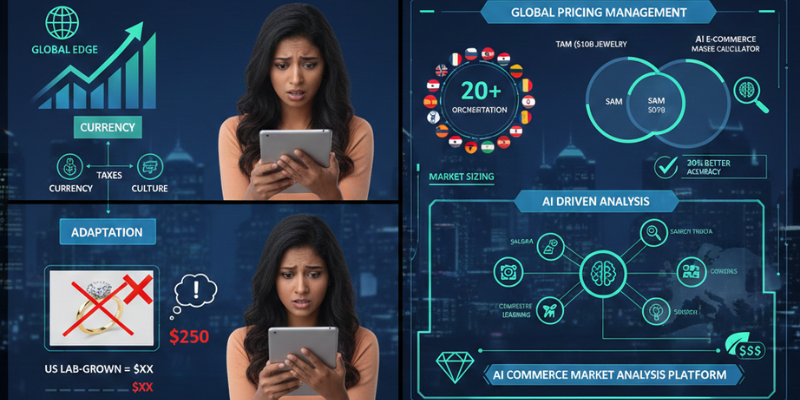
Market sizing isn’t guesswork; it’s the foundation of international pricing. How to do data driven market sizing for AI commerce? Begin with top-down analysis: start broad with global e-com stats ($6.5T in 2025), then drill to niches like jewelry ($500B cross-border potential). Bottom-up? Aggregate competitor sales and shopper data via market sizing service for brands.
Priya’s playbook: Use steps to size e-commerce markets with data. First, define your TAM—global jewelry e-com at 15% CAGR. Then SAM: US and EU platforms like Etsy and Zalando. SOM factors price pressure—affordable luxuries under $200. An AI e-commerce market size calculator from cross-border e-commerce analytics revealed her US SOM at $50M, guiding pricing for international markets.
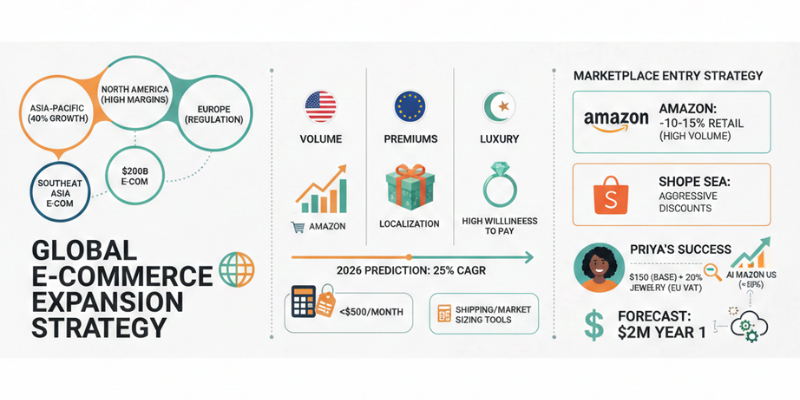
Where to expand? Data driven playbook AI commerce expansion highlights Asia-Pacific (40% growth), North America (mature, high margins), and Europe (regulation-heavy). Priya targeted Southeast Asia first—$200B e-com boom, low price pressure on mid-tier jewelry.
Break it down: US for volume (Amazon dominance), EU for premiums (localization wins), MENA for luxury (high willingness to pay). Cross border market sizing guide 2026 predicts 25% CAGR, but success hinges on calculating shipping costs ecommerce via tools like global market sizing software price under $500/month.
Marketplace-by-marketplace entry strategy turns data into action. Amazon? Low price pressure, high volume—price 10-15% below retail. Etsy? Premium pricing for international markets, emphasizing handmade stories. Shopee in SEA? Aggressive discounts to build share.
Priya’s win: AI tools for market sizing in global commerce showed Amazon US jewelry searches spiking 20%. Her international pricing process adjusted: $150 base, +20% for EU VAT. Best e-commerce market sizing software integrated cross-border e-commerce analytics, forecasting $2M first-year revenue.
Compliance & taxes checklist is non-negotiable. EU VAT (20-27%), US sales tax (varies by state), India’s GST for exports. Miss it, and price pressure intensifies from fines. Use global pricing management dashboards to auto-calculate. Priya’s checklist: Register for OSS in EU, track nexus in US, leverage free trade zones in SEA.
Cross-border logistics architecture streamlines calculate shipping costs ecommerce. DHL integrations in market sizing service for brands cut costs 25%. Priya mapped: India to US (7-10 days, $15/unit), factoring duties. AI predicts delays, stabilizing international pricing.
How AI changes market sizing for brands? Real-time rerouting avoids stockouts, maintaining prices amid volatility. Tools like Flexport optimize, tying into AI commerce market analysis platform.
Localisation strategy adapts everything. Translate listings, culturally tweak designs—Priya added zodiac motifs for Asia. Pricing for international markets shines here: Dynamic pricing adjusts for festivals (Diwali boosts 50%).
Digital marketing for new markets amplifies: TikTok in US, Instagram in EU. Global ecommerce sizing software segments audiences, cutting CAC 40%.
Mistakes to avoid? Static pricing ignores price pressure—competitors undercut daily.Priya nearly did, but how to build market sizing model AI ecom saved her: Scenario modeling showed 15% hikes viable in the EU.
Overlooking calculated shipping costs ecommerce erodes margins. Skipping compliance? Fines galore. Ignoring data silos? No international pricing process.Tools & tech stack for global scaling—like cross border market sizing service—prevent this.

Tools & tech stack: Best e-commerce market sizing software (SimilarWeb), AI e-commerce market size calculator (Jungle Scout), global market sizing software price ($99-$999/mo). Stack: Brand Central™ for cross-border e-commerce analytics, Shopify for ops, Google Analytics for insights.
Priya's stack measured ROI via market sizing service for brands, hitting 3x growth.
How to measure success? Track GMV uplift, margin stability amid price pressure, expansion ROI. KPIs: 20% revenue from new markets, <10% cart abandonment from shipping surprises.
Priya celebrated: 35% margin post-global pricing management, $5M GMV Year 1. Informational guide cross border sizing AI benchmarks this.
Scaling globally demands precision, where what is international pricing evolves into a symphony of data and strategy. Priya's brand now thrives across continents, margins intact despite price pressure, thanks to robust global pricing management and a flawless international pricing process. Your turn awaits—explore Assiduus Global'scross border market sizing service today. Book a demo for your AI commerce market analysis platform and unlock the playbook that powers Fortune 500 growth. Accelerate now!